Materials2Market / Insights / Ohio Senate 2026
U.S. Midterms Playbook for Canadian Business · Series 01
Ohio: Husted v. Brown on Data Centres
What the Ohio Senate race means for Canadian companies exposed to data-centre permitting, grid costs and U.S.–Canada electricity trade.
Published October 25, 2026 · Jared Fisk
← Start with the trailer — how to read this series, and the six U.S. Senate races it covers.
Data Centres & AI
The candidates in this race are offering different approaches:
Ohio: both candidates support locals having a say; Husted’s bill proposed that all states consider (not mandate) making data centres pay for grid upgrades. A separate bipartisan permitting bill, introduced Sep 30, 2026, would require data centres of at least 20 MW to pay the grid costs they add.
Federal and cross-border context
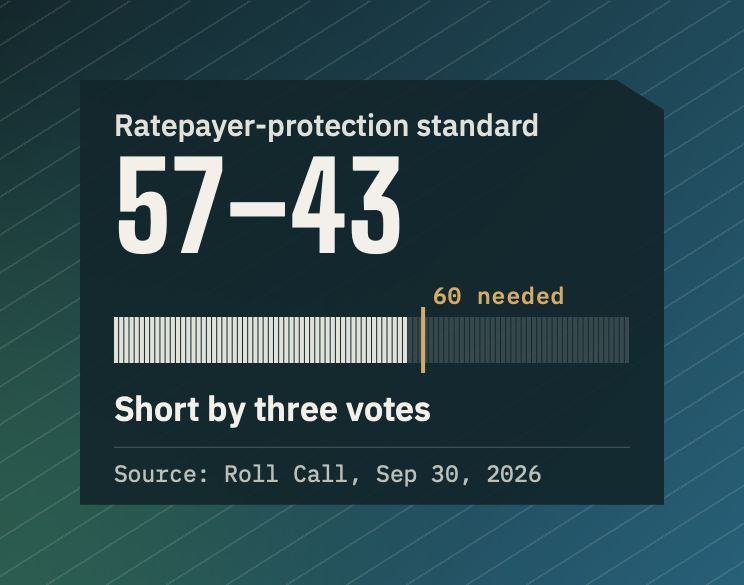
- On Sep 17, 2026, Senator Husted, Ohio (R) failed to get unanimous consent to pass his Ratepayer Protection Act in the Senate; the House version, H.R. 9340, passed 417–3. On Sep 30, 2026, a Senate vote to advance H.R. 9340 fell short of the 60 needed, 57–43.
- US–Canada electricity trade was worth $3.2B in 2025, 67% of it imports from Canada; Ontario Premier Doug Ford’s threat to cut power to Minnesota, Michigan and New York is back on the table, though in August he said “we need to get together and decide if we’re going to put surcharges on the electricity”, under increased trade tensions.
- Earlier this month, Ontario’s grid operator inked a six-month deal to import 600 MW of U.S. power; coming from Alpha Generation, starting November 1, it will be used to cover winter maintenance at generating stations, including at Pickering.
If Republicans hold the Senate: A Republican majority would strongly encourage Husted to bring his bill back; it drew 57 votes on September 30. Either way, the bipartisan permitting bill, which would make data centres of at least 20 MW pay their grid costs, won’t get a vote until after the election; sponsors hope to pass it in November.
If Democrats win the Senate: Most Democrats voted against advancing Husted’s bill and four voted for it (senate.gov roll call 254); a Democratic majority would likely repackage it to be more favourable towards oversight and local approvals, or write their own.
Ohio special: Husted (R) v Brown (D)
- Ohio is facing a load problem with American Electric Power (AEP), with projected data centre load outpacing customer load.
- Data centres have become a central theme in a heated election for Ohio’s Senate seat.
- No debates are planned in the Ohio race, so there’s no recorded debate exchange on data centres from either candidate.
- Sherrod Brown’s (D) billboards call Husted “The Face of Data Centers” and his ads say he will “require the data centers pay the full cost of their electricity, not you”.
- Jon Husted (R) said before the Senate vote, which failed, that if Democrats blocked his bill, it would prove “they do not care about affordability”.
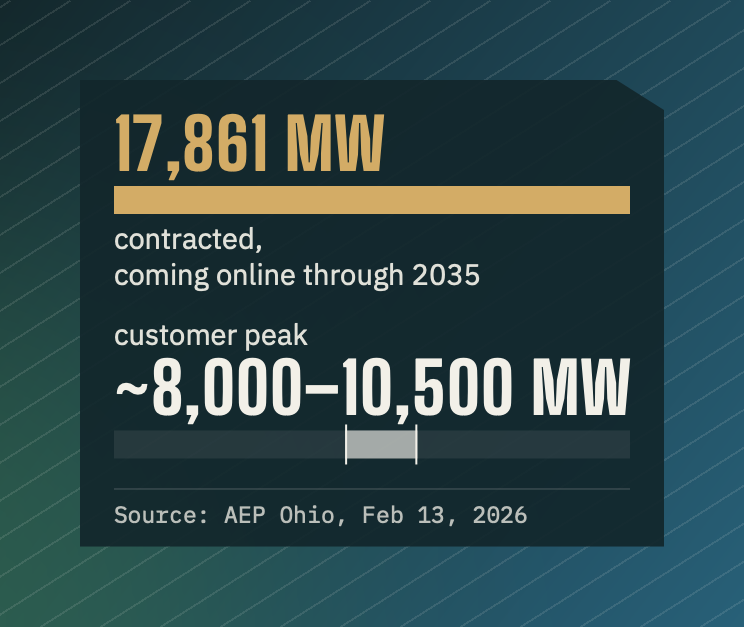
- AEP Ohio’s 17,861 MW of contracted data-centre load coming online through 2035, and a current customer peak of 8,000–10,500 MW (as of Feb 2026).
- Grid operator PJM Interconnection’s (PJM) 2028/29 capacity auction hit the $325/MW-day cap.
- On Oct 9, the Federal Energy Regulatory Commission (FERC) rejected most of PJM’s proposal for new data-centre load, including cutting power first to large data centres that don’t bring their own supply; it kept only a 50 MW large-load definition and a registry.
- Earlier this month, Ohio’s residential utility advocate identified rising energy costs coming from “an explosive amount of demand primarily coming from data centers” (Richland Source, Oct 21, 2026).
- In August, a Republican Senate campaign committee warned tech companies that Ohio voters’ sentiment towards data centres had soured, and if it did not change, the campaign against them could spread far beyond Ohio.
- Both candidates agree – data centres should pay for their own power.
Missing
- Missing perspective: Capital Power is a Canadian company that is pitching an Ohio gas plant as a data centre site that can be co-located, but the issue remains who will pay for the power.
- Missing picture: As early as this past spring, Ohio Governor Mike DeWine paused new data-centre tax exemption requests on May 27, 2026; Husted backed DeWine’s original push for data centres, as lieutenant governor.
- Data centres have taken centre stage in Ohio, with limits or bans part of 18 Ohio communities’ November 3 ballots.
- Missing narrative: Both candidates agree the centres should pay for their own power; they disagree on the tax breaks.
What if
If the Republican wins: Husted’s blocked bill may well be reintroduced, and his desire to have states consider a standard making large data centres pay for grid upgrades. He will have to balance that with his bill’s aim to save ratepayers and families from footing the bill in the event a data-centre company delays, downsizes, or abandons its projects.
If the Democrat wins: Brown says communities should decide whether data centres are built. His criticism around data centres is also putting him at odds with some building trades in the state that want more projects, more work. The Cleveland Building & Construction Trades Council endorsed the Republican, Husted, in October 2025; so did the Northwest Ohio building trades and Operating Engineers Local 18 and Local 66; most labour groups, including the Columbus/Central Ohio Building and Construction Trades Council, back Brown as of October 19, 2026.
🇨🇦 Exposure
- Capital Power Corporation (TSX: CPX, Edmonton) · Ohio (and Michigan) · Data centres
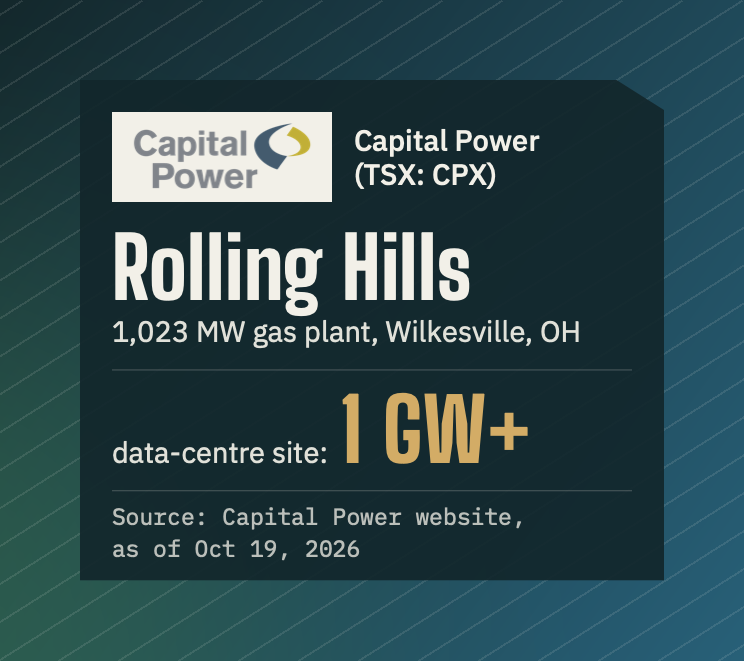
- At stake: Rolling Hills, gas plant site in Wilkesville, Ohio 1,023 MW; identified as a new 1 GW+ data-centre site with power available 2029; also owns 50% of Michigan’s Midland Cogeneration Venture, which is not marked for data centre usage.
If Republicans win: Husted’s initial bill asks states to consider making data centres pay for their own grid upgrades, which co-located generation sites fit (like Rolling Hills); the bipartisan permitting bill would go further and require it.
If Democrats win: fewer data centre projects in Ohio, reducing the potential for future buyers of the Capital Power site; may still prioritize sites that are self-generating.
Renewables & Clean Energy
For Canadian business hoping for a windfall victory at the Senate level to restore wind and solar credits, it’s unlikely before 2029. But what should be your next focus following Trump’s One Big Beautiful Bill Act (OBBBA)?
A newly elected Senator, on either side, could reset the conversation around more or less cuts, and for how long until they’re renegotiated.
Missing perspective
- OBBBA was signed on July 4, 2025, and it rolled back the tax breaks to renewables from Biden’s 2022 Inflation Reduction Act.
- Wind and solar companies can only keep those tax breaks if they had started construction by July 4, 2026 (that deadline has now passed; a June 6 federal court ruling restored the 5% safe harbor before it) or are placed in service by the end of 2027.
- For battery storage, hydro, geothermal, and nuclear, the runway for the tax breaks allows for more opportunity, so start building by the end of 2033.
- 76% of solar and 86% of wind projects due online by the end of 2028 had already been safe-harbored (counted as having started construction) (as of Nov 2025, per LevelTen Energy).
- OBBBA kept the storage credit but added foreign-sourcing limits.
Missing narrative
- The Senate vote was tied 50–50 until Vice President JD Vance broke the tie.
- Who voted for the bill that rolled back the tax credits?
- Senators: Husted (R), Ohio; Sullivan (R), Alaska
- Representative Hinson (R), Iowa in the House
- Who voted against that bill?
- Senator Collins (R), Maine
- The Senate split 50–50 on July 1, 2025, and the Vice President broke the tie (51-50). Husted and Sullivan voted Yea; Collins voted Nay. The vote was on the whole bill, not the tax credits alone, and Republicans Paul and Tillis also voted Nay. Hinson voted Aye in the House.
If Republicans hold the Senate: The deadlines in the law stay as written.
If Democrats win the Senate: Democratic leaders have pledged to bring the credits back, but a new law would still need the President’s signature.
🇨🇦 Exposure
- Brookfield Renewable Partners L.P. (TSX: BEP.UN / BEPC; NYSE: BEP / BEPC) · Texas, Ohio, Michigan, Minnesota · Renewables
- At stake: Geronimo Power has 1,352 MW in Texas, 675.5 MW in Ohio and 165 MW each in Michigan and Minnesota, operating or under construction (Brookfield Renewable Q1 release, May 2, 2025); with La Caisse, Brookfield agreed to acquire Boralex, completed Aug 14, 2026.
If Republicans win: the 2027 cutoff to be in service for wind and solar projects holds, with storage projects receiving credits for construction started by the end of 2033.
If Democrats win: puts pressure on Senate to restore the credits for wind and solar post 2027, but it isn’t expected before 2029 at the earliest.
About the author
Jared Fisk is an award-winning storytelling architect who helps mining, energy and cleantech companies define their narrative, build the content that carries it, and amplify it until the market repeats it. He works where communications, government relations and AI meet: reading how a story will land with investors, regulators and the machines that now summarize it.
Read this as a newsletter on Substack → · subscribe there to get the next race in your inbox.
Let's build the story.
Tell me what the market still doesn't understand about your company. I read every message myself.
Send a note