Materials2Market / Insights / Michigan Senate 2026
U.S. Midterms Playbook for Canadian Business · Race 3 of 5 · Michigan
Michigan: America’s only working Nickel Mine Trades on the TSX
Michigan: 2026 U.S. Senate Midterms Playbook for Canadian Business
Published October 31, 2026 · Jared Fisk
Michigan Senate 2026 (Rogers v. El-Sayed) in 30 seconds
- Two Canadian-listed companies, Talon Metals and Highland Copper, own Michigan’s Eagle Mine and Copperwood projects, and Vancouver-based Lundin Mining has a stake in Talon.
- The money to push Copperwood through comes from the state and a non-binding offer from the U.S. Export-Import Bank, not the Senate.
- Fortis (ITC): A Canadian utility is looking to see what happens, because much of the project’s spending falls outside of 2030.
- Rogers (R) and El-Sayed (D): Both candidates back a state moratorium on data centres, but it’s a local and state legislature decision, not theirs.
Read this as a newsletter on Substack → · subscribe there to get the next race in your inbox.
← Start with the launch post — how to read this series, and the five U.S. Senate races it covers.
The race at a glance
| State | Race | Cook | Sabato | Inside Elections | Sectors |
|---|---|---|---|---|---|
| Michigan | Rogers (R) v El-Sayed (D), open | Toss-up | Lean D | Tilt D | All four |
How these ratings were checked
Covered in the Texas race post (table notes): Texas, Part 1 →
Mining
Missing perspective: Two Canadian-listed companies, Talon Metals and Highland Copper, own these projects, and Vancouver-based Lundin Mining has a stake in Talon.
Michigan: Rogers (R) v El-Sayed (D)
Missing narrative: Neither the Democrat nor the Republican candidate has stated their position on Eagle Mine, Copperwood, or critical minerals; the Oct 8 debate did not cover mining, and a second debate was held Oct 21; coverage shows no mention of mining.
The race in detail
Canada did come up: tariffs on Canadian goods were asked about at both debates, and at the Oct 8 debate Rogers said of the Canada tariffs, “I think we need to end it” (his campaign ad that week said “we need to end this tariff war now”).
What if
If the Republican wins: No statement on the record has been made by Rogers on any of these projects; the outcome is unclear.
If the Democrat wins: No statement on the record has been made by El-Sayed on any of these projects; the outcome is unclear.
Factors at play for both parties
Federal permits, U.S. equity stakes in Canadian miners, and the SPEED Act
- The White House, through Executive Order 14241 (March 20, 2025), directed agencies to expedite priority mineral permits.
- The U.S. government, under the Trump Administration, now holds equity in two Canadian mining companies, Trilogy Metals (Department of War) and Lithium Americas (Department of Energy), and in U.S.-based MP Materials.
- Trilogy’s stake closed September 11, 2026; no other U.S. stakes in Canadian miners have been announced.
- The Standardizing Permitting and Expediting Economic Development (SPEED) Act passed the House 221–196 on Dec 18, 2025.
- Needs 60 Senate votes, but Congress is in recess until after the midterms; a separate bill, the Bipartisan American Affordability and Jobs Act of 2026, was introduced in the Senate on Sep 30, 2026 and includes project certainty and environmental provisions.
- Missing perspective: What’s the response from the Canadian government? Could they consider doing the same to backstop critical projects themselves?
If Republicans hold the Senate: Committee chairs remain Republican, which means the request to review government equity in Canadian-owned projects is limited to the minority party; Democratic ranking members already asked the GAO on Aug 12, 2026 to review these deals.
If Democrats win the Senate: Democrats will chair committees and push the Government Accountability Office (GAO) to review government equity stakes in current projects, building on the request they already made as the minority.
🇨🇦 Exposure — Talon Metals Corp. (TSX: TLO) · Michigan · Mining
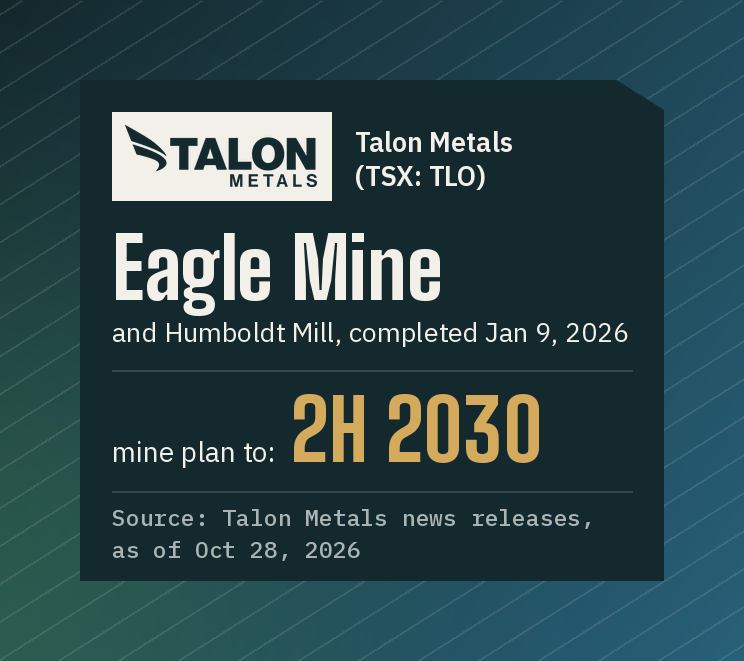
At stake: TSX-listed Talon Metals Corp. (TSX: TLO) owns the Eagle Mine and Humboldt Mill (completion announced Jan 9, 2026); Lundin Mining Corporation (TSX: LUN) held ~19.86% of Talon at closing.
Eagle’s reserve-backed mine plan runs to the second half of 2030.
In September, Talon chose the Humboldt Mill to process ore from its Tamarack project in Minnesota, and reported a US$20.6M U.S. Department of War exploration grant.
🇨🇦 Exposure — Highland Copper Company Inc. (TSXV: HI) · Michigan · Mining
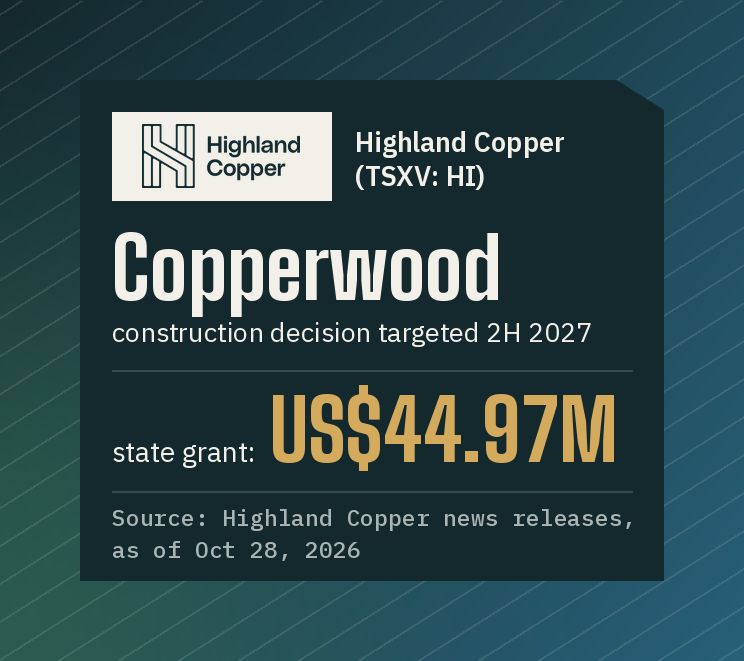
At stake: Highland Copper Company Inc.’s (TSXV: HI) Copperwood project: final state grant approval of US$44,971,691, part of a US$50 million grant, announced Aug 25, 2026; a non-binding Export-Import Bank of the United States (EXIM) Letter of Interest for up to US$250M (September 2025).
Highland is targeting a construction decision in the second half of 2027.
Renewables & Clean Energy
Missing perspective: A Canadian utility is looking to see what happens, because much of the project’s spending falls outside of 2030.
Michigan: Rogers (R) v El-Sayed (D)
The race in detail
Where each candidate stands, Michigan’s clean-energy law, and Fortis/ITC
(D) El-Sayed wants renewable energy and lots of it; he says we need 100% renewable energy.
(R) Rogers does not like clean energy mandates because “it’s costing us all pretty dearly,” in the form of increased energy costs for the state and its citizens.
By 2040, Michigan State law demands 100% clean energy, and 60% renewable energy by 2035; only Democrats voted for it, no Republicans voted for it at the state level.
Canadian companies with exposure: Fortis Inc. (TSX/NYSE: FTS), and its US-based power lines company, ITC Holdings Corp., wants to build and create the infrastructure to power the renewables, but most of that work comes after 2030.
ITC estimates US$3.7–4.2B of Midcontinent Independent System Operator (MISO) tranche 2.1 in Michigan and Minnesota plus Iowa upgrades; only US$0.4B is in the 2026–2030 plan. Fortis releases a new 2027–2031 capital plan on Nov 3, 2026, election day.
Missing picture: Does this Senate outcome change the strategy for a Canadian company that is betting big on the Midwest’s push for clean energy?
Missing narrative: MISO’s board approved tranche 2.1 on December 12, 2024.
The remaining approvals are on the state regulators and the Federal Energy Regulatory Commission (FERC); Senate has no impact; a complaint at FERC from five state commissions against tranche 2.1 is still pending; on Oct 4, the states asked FERC to act.
What if
If the Republican wins: Rogers opposed clean energy mandates because he’s concerned about increased costs for ratepayers; but those mandates are state law; his stance on the transmission is unclear.
If the Democrat wins: El-Sayed wants to see more renewable energy and wants it expedited; his stance on the transmission is unclear.
🇨🇦 Exposure — Fortis Inc. (TSX/NYSE: FTS, St. John’s) through ITC Holdings Corp. · Michigan, Minnesota, Iowa · Renewables (transmission)
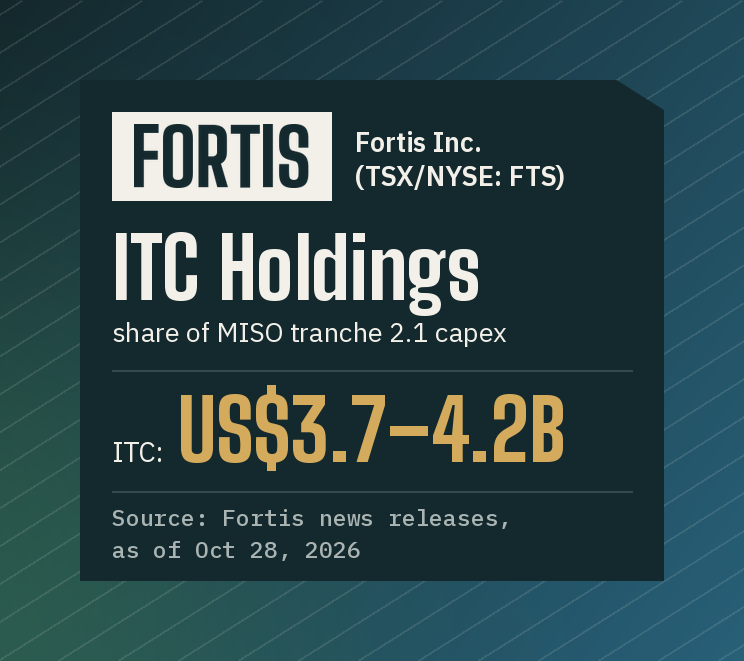
At stake: ITC’s share of the MISO tranche 2.1 transmission capex is roughly US$3.7–4.2B, of which only US$0.4B is in the 2026-2030 capital plan.
What if
If Republicans win: opposition to renewable energy mandates, likely, means less wind and solar, which weakens the need for new transmission sources.
If Democrats win: increased demand for renewable energy increases the need for transmission; the risk becomes ratepayers paying higher costs to access renewable energy.
🇨🇦 Exposure — Brookfield Renewable Partners L.P. (TSX: BEP.UN / BEPC; NYSE: BEP / BEPC) · Texas, Ohio, Michigan, Minnesota · Renewables
Brookfield’s full breakdown across Texas, Ohio, Michigan and Minnesota is in Texas, Part 1.
Data Centres & AI
Missing perspective: Currently, there is no Canadian data-centre project identified in this race; Capital Power owns 50% of Michigan’s Midland Cogeneration Venture, which Capital Power’s Midland page doesn’t market for data centres.
Michigan: Rogers (R) v El-Sayed (D)
The race in detail
The OpenAI/Oracle-linked 1.4 GW data centre in Saline Township (under construction; the state attorney general’s appeal of the approval is pending); (R) Rogers backs a one-year state moratorium; (D) El-Sayed expressed support for state and local moratoriums in a September FOX 2 interview, reported again on Oct 1.
Missing picture: Both candidates back a state moratorium on data centres, but it’s a local and state legislature decision, not theirs; Rogers said as much at the Oct 8 debate: local governments should decide.
Missing narrative: The fact both candidates support the pause, limits the partisan issues related to AI and data centres in this race.
Factors at play for both parties
State AI laws, and Ontario’s power imports
- OBBBA initially included a state-AI-law moratorium, championed in the Senate by Senator Ted Cruz (R), Texas; and was moved to be stripped by Senator Marsha Blackburn (R), Tennessee.
- Senators voted 99–1 to remove the state-AI-law moratorium, which meant states keep the power to make their own AI laws; however, a December 2025 executive order directs the Justice Department to challenge state AI laws in court; in April 2026, the Justice Department moved to join xAI’s lawsuit against Colorado’s AI law.
- Earlier this month, Ontario’s grid operator inked a six-month deal to import 600 MW of U.S. power; coming from Alpha Generation, starting November 1, it will be used to cover winter maintenance at generating stations.
Which Canadian companies have the most at stake in Michigan?
| Company | Ticker | Michigan projects | At stake | Source |
|---|---|---|---|---|
| Talon Metals Corp. | TSX: TLO | Eagle Mine and Humboldt Mill | Mine plan runs to 2H 2030 | Talon Metals |
| Lundin Mining Corporation | TSX: LUN | Stake in Talon | ~19.86% of Talon at closing | Lundin Mining |
| Highland Copper Company Inc. | TSXV: HI | Copperwood | US$44,971,691 state grant | Highland Copper |
| Fortis Inc., via ITC Holdings | TSX/NYSE: FTS | MISO tranche 2.1 | US$3.7–4.2B (US$0.4B in the 2026–2030 plan) | Fortis |
| Brookfield Renewable, via Geronimo Power | TSX: BEP.UN | Geronimo Power projects | 165 MW in Michigan | Geronimo Power |
| Capital Power Corporation | TSX: CPX | Midland Cogeneration Venture | 50% owner | Capital Power |
Figures as of Oct 28, 2026, from the sources linked.
Read this as a newsletter on Substack → · subscribe there to get the next race in your inbox.
More from the playbook
- Launch: how to read this playbook
- Race 1 · Ohio · data centres, federal and cross-border context
- Race 2 · Texas, Part 1 · the federal tax-credit picture for wind, solar and storage · Thu Oct 29
- Race 4 · Alaska, Part 1 · federal permits, U.S. equity stakes in Canadian miners and the SPEED Act · Thu Oct 29
- Race 2 · Texas, Part 2 · Fri Oct 30
- Race 3 · Michigan (you’re here)
- Race 5 · Minnesota · Sun Nov 1
- Race 4 · Alaska, Part 2 and the full playbook · Mon Nov 2
About the author
Jared works where communications, government relations and AI meet: reading how a story will land with investors, regulators and the machines that now summarize it.
Views are personal and not financial advice.
Let's build the story.
Tell me what the market still doesn't understand about your company. I read every message myself.
Send a note