
Materials2Market / Insights / Texas Senate 2026, Part 2
U.S. Midterms Playbook for Canadian Business · Race 2 of 5 · Texas, Part 2
Texas, Part 2: Ontario Teachers’ Pension, Texas AI Bet
Texas, Part 2: 2026 U.S. Senate Midterms Playbook for Canadian Business
Published October 30, 2026 · Jared Fisk
Texas Senate 2026 (Paxton v. Talarico), Part 2, in 30 seconds
- Canadian-linked capital sits in at least two Texas data centre campuses, including the Compass campus in Red Oak (Compass is co-owned by Brookfield Infrastructure and the Ontario Teachers’ Pension Plan); the other is Hut 8’s Beacon Point.
- In Texas, there is no division along party lines about who should pay for data centres and AI infrastructure.
- Both candidates agree: they want to end data-centre tax breaks; roughly $3.2 billion in forgone state revenue over 2026–27, by the Comptroller’s 2025 estimate; the Comptroller’s office now expects a significantly higher figure.
Read this as a newsletter on Substack → · subscribe there to get the next race in your inbox.
← Start with the launch post — how to read this series, and the five U.S. Senate races it covers.
The race at a glance
| State | Race | Cook | Sabato | Inside Elections | Sectors |
|---|---|---|---|---|---|
| Texas | Paxton (R) v Talarico (D), open | Toss-up | Toss-up | Toss-up | Data centres |
How these ratings were checked
Covered in the Texas, Part 1 post (table notes): Texas, Part 1 →
Data Centres & AI in Texas
Texas: Paxton (R) v Talarico (D)
Missing perspective: Canadian-linked capital sits in at least two Texas data centre campuses, including the Compass campus in Red Oak (Compass is co-owned by Brookfield Infrastructure and the Ontario Teachers’ Pension Plan); the other is Hut 8’s Beacon Point.
Missing picture: A senator cannot change state law around tax exemptions.
Missing narrative: Both candidates support stricter control over data centres; the choice for voters is between fewer federal rules for self-powered data centres (Paxton) and federal minimums plus local approval (Talarico).
The race in detail
Where each candidate stands, Abbott’s audit and permit pause, and the data-centre tax break
- In Texas, there is no division along party lines about who should pay for data centres and AI infrastructure. Companies that want to build in Texas need to pay their own way. In Ohio, a slightly different approach, same outcome…pay for your own power consumption.
- The candidates in these states are offering different approaches:
- Texas: (R) Paxton supports carving out exemptions from federal regulation for off-grid power; (D) Talarico backs minimum federal requirements and local approval.
- In early August, Governor Abbott ordered an audit of data centres advancing through the Electric Reliability Council of Texas (ERCOT), pausing new data-centre grid connections until it’s done, and ordered a halt to all state environmental (TCEQ) permits sought by data-centre projects in September, which appears to include permits for on-site power plants.
- On Oct 19, watchdog groups Public Citizen and FracTracker reported that some data-centre permits, mostly construction stormwater, were still approved after the order. By Oct 21, the state environmental agency had suspended the stormwater approvals and temporarily shut down its online permit system; the Governor’s office says “no permits have been approved.”
- ERCOT aims to file its audit by Dec 10, 2026.
- This comes after reports of unprecedented load growth, with 474 GW of interconnection requests, which the Governor’s letter calls “more than five times Texas’ record peak electricity demand,” with “approximately 90 percent” of new requests from data centres.
- Both candidates are being pressured by voters who are upset by the drain on power and water from data centres, and by rising electricity bills.
- Both candidates agree: they want to end data-centre tax breaks; roughly $3.2 billion in forgone state revenue over 2026–27, by the Comptroller’s 2025 estimate; the Comptroller’s office now expects a significantly higher figure.
- (D) Talarico has made data centres an attack line; his campaign says “Texans can’t afford a senator who’s bought by big data center companies”; (R) Paxton says “If you’re going to build a data center, you have to generate enough of your own power”
What if
If the Republican wins: Paxton supports the Decentralized Access to Technology Alternatives (DATA) Act, which means reduced federal regulations for off-grid power; says data centres are “a yes with conditions” and shouldn’t go “right next to somebody’s house”.
If the Democrat wins: Talarico wants minimum federal requirements to protect the grid, environment and jobs.
Factors at play for both parties
State AI laws
- OBBBA initially included a state-AI-law moratorium, championed in the Senate by Senator Ted Cruz (R), Texas; Senator Marsha Blackburn (R), Tennessee, moved to strip it.
- Senators voted 99–1 to remove the state-AI-law moratorium, which meant states keep the power to make their own AI laws; however, a December 2025 executive order directs the Justice Department to challenge state AI laws in court; in April 2026, the Justice Department moved to join xAI’s lawsuit against Colorado’s AI law.
🇨🇦 Exposure — Brookfield Infrastructure Partners L.P. (NYSE: BIP; TSX: BIP.UN) and Brookfield Asset Management Ltd. (NYSE/TSX: BAM) · Texas and Virginia · Data centres
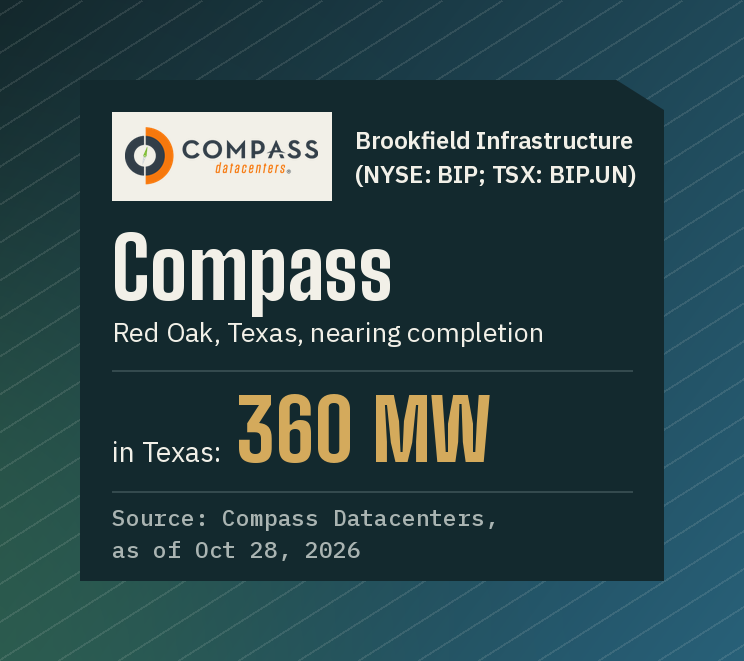
At stake: Compass, co-owned by Brookfield Infrastructure and the Ontario Teachers’ Pension Plan: 360 MW in Red Oak, Texas (nearing completion); 79 MW in Loudoun, Virginia.
In April 2026, Compass pulled out of its 825-acre portion of the Prince William Digital Gateway project near Gainesville, Virginia, after the Virginia Court of Appeals blocked it in March, amid community opposition and a stalled state debate over data-centre tax incentives. Its Loudoun campus is a separate site.
Brookfield raised its financing framework with Bloom Energy to US$25B.
What if
If Republicans win: on-site generation suppliers could benefit from Paxton’s support for exempting off-grid power from federal regulation. Texas’s permit pause appears to cover on-site power plants too.
If Democrats win: projects would need to receive local approval under Talarico’s plan, meet federal minimum requirements and lose the state sales-tax break, increasing the process and costs to build.
🇨🇦 Exposure — Hut 8 Corp. (Nasdaq/TSX: HUT, Miami; successor to British Columbia’s Hut 8 Mining Corp.) · Texas · Data centres
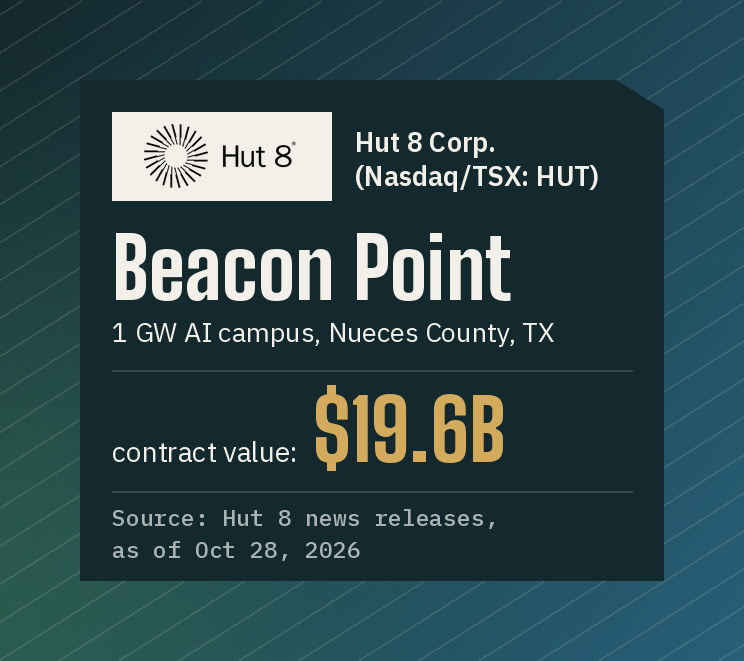
At stake: Beacon Point, a fully commercialized 1 GW AI campus in Nueces County, TX, has $19.6B in campus base-term contract value, according to Hut 8.
Recently won court approval to buy two more Texas sites for up to $180M; the sale has not closed yet.
What if
If Republicans win: self-generating data centres that do not add load to the existing grid are preferred; end the sales-tax breaks, and back keeping them away from homes; Texas has also paused state permits for data-centre projects, which appears to include on-site power plants, until its audit is done, ordered by Governor Abbott.
If Democrats win: end the sales tax breaks, stricter federal regulations and more local say over new projects; existing long-term leases (Hut 8) could soften impact.
Which Canadian-linked companies have the most at stake in Texas data centres?
| Company | Ticker | Texas projects | At stake | Source |
|---|---|---|---|---|
| Brookfield Infrastructure and Ontario Teachers’ Pension Plan, via Compass | NYSE: BIP; TSX: BIP.UN | Compass campus, Red Oak | 360 MW (nearing completion) | Compass Datacenters |
| Hut 8 Corp. | Nasdaq/TSX: HUT | Beacon Point, Nueces County | 1 GW AI campus; US$19.6B campus base-term contract value | Hut 8 |
Figures as of Oct 28, 2026, from the sources linked.
Read this as a newsletter on Substack → · subscribe there to get the next race in your inbox.
More from the playbook
- Launch: how to read this playbook
- Race 1 · Ohio · data centres, federal and cross-border context
- Race 2 · Texas, Part 1 · the federal tax-credit picture for wind, solar and storage · Thu Oct 29
- Race 4 · Alaska, Part 1 · Thu Oct 29
- Race 2 · Texas, Part 2 (you’re here)
- Race 3 · Michigan · Sat Oct 31
- Race 5 · Minnesota · Sun Nov 1
- Race 4 · Alaska, Part 2 and the full playbook · Mon Nov 2
About the author
Jared works where communications, government relations and AI meet: reading how a story will land with investors, regulators and the machines that now summarize it.
Views are personal and not financial advice.
Let's build the story.
Tell me what the market still doesn't understand about your company. I read every message myself.
Send a note